
Overview
The UB simulation platform is designed for UB base specifications and systems. Its functional modules include the simulation framework, and computing, memory, and communication subsystems. This platform allows the UB community to delve into the UB interconnect, fostering new ideas for its evolution and architectural innovation.
Architecture
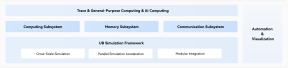
- Trace & General-Purpose Computing & AI Computing: BenchLib, an automated benchmark generation tool with unified standard interfaces, captures and generates live network traffic characteristics, abstracting them into workload datasets for open-source use and research.
- Computing Subsystem: Provides XPU simulation functionality with internal modules implemented according to open-source IP cores. Core components include the compute unit, memory and interconnects, and the instruction building module. Capabilities cover collective communication operators, HCCL, and shmem operators.
- Memory Subsystem: Provides UB memory pooling simulation; supports global addressing, UMMU, and decoder simulation. Its memory backend covers storage media including DDR4, DDR5, LPDDR5, and HBM3, supporting dynamic hardware features such as multi-channel configurations and row buffers.
- Communication Subsystem: Provides protocol frameworks and algorithms across the UB function, transaction, transport, network, and data link layers. Core network components including UB Switch, UB Port, and UB Link support the simulation of UB network topologies and memory-semantic transmissions.
- UB Simulation Framework: A unified multi-simulator platform based on the PDES process-level parallel architecture. It achieves low-intrusive integration of multi-scale simulators via standard adaptation interfaces and provides declarative topology configurations to define simulators and their connectivity for building co-simulation scenarios.
- Automation & Visualization: Provides a drag-and-drop UI that allows you to pull simulator nodes from a component panel and interconnect them to build co-simulation scenarios. Supports online parameter editing, real-time status monitoring, log output, and visualization of simulation results.